From the founders
Do you really need to meet every job qualification to get an interview?
· 9 min read · By Tal Flanchraych, Founder of ApplyAll
Some ApplyAll customers ask us to apply only to jobs where they’re “100% qualified.” That’s an understandable request. Nobody wants to spend their evening applying for a job they never had a shot at.
There are a lot of reasons why a job posting lists “requirements” that are more flexible than they appear, but the main way to interpret a job post is an imperfect description of an ideal candidate:
- Requirements can change during the hiring process.
- Recruiters, Hiring Managers, and the C-Suite may have very different ideas about what a job requires.
- There may be factors notincluded in the job description that matter more than anything explicitly listed.
- Teams may be hiring for a role they don’t fully understand.
So what is the threshold? When is enough, enough?
We track the outcomes of thousands of job applications every month across a range of white-collar professions. Using our data, we can take a stab at empirically answering this question.
If you’re impatient like us, here’s the takeaway:
Of all the interviews in our database which could be successfully tied to a specific resume, the successful resumes leading to those interviews met an average of 66.5% of the job’s explicit professional must-haves and 53.4% of its nice-to-haves, where those categories were listed.
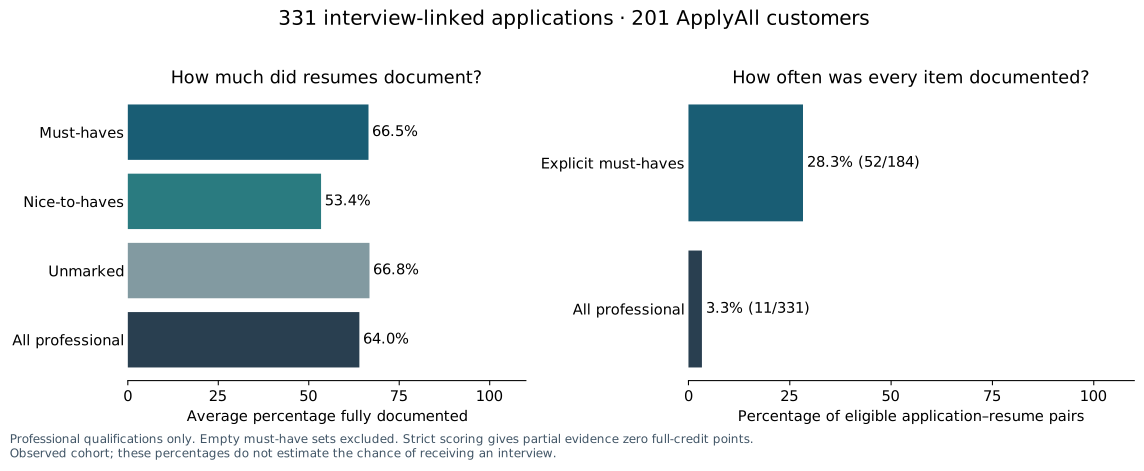
Most successful resumes don’t meet every qualification in a job post.
We tried to be very conservative in our analysis, looking only at resume-interview pairs we are confident represented a real interview with a real human working at the company (so excluding automated assessments, recruiter screenings etc. see “methodology” section below).
That left us with a set of 331 resume-interview pairs to work with.
Only 11 of the 331 (3.3%) fully documented every professional qualification, including nice-to-haves and unmarked items. Perfect matches do happen, but they are the exception not the rule.
Only 52/184 (28.3%) of successful resumes matched all of the “must-haves” listed in the job description.
This does not mean “meet two-thirds of the requirements and you’ll probably get an interview.” But it does mean meeting less than 100% of the qualifications (nay even less than 60% of the qualifications) is nota deal breaker, in fact it’s the norm.
Methodology
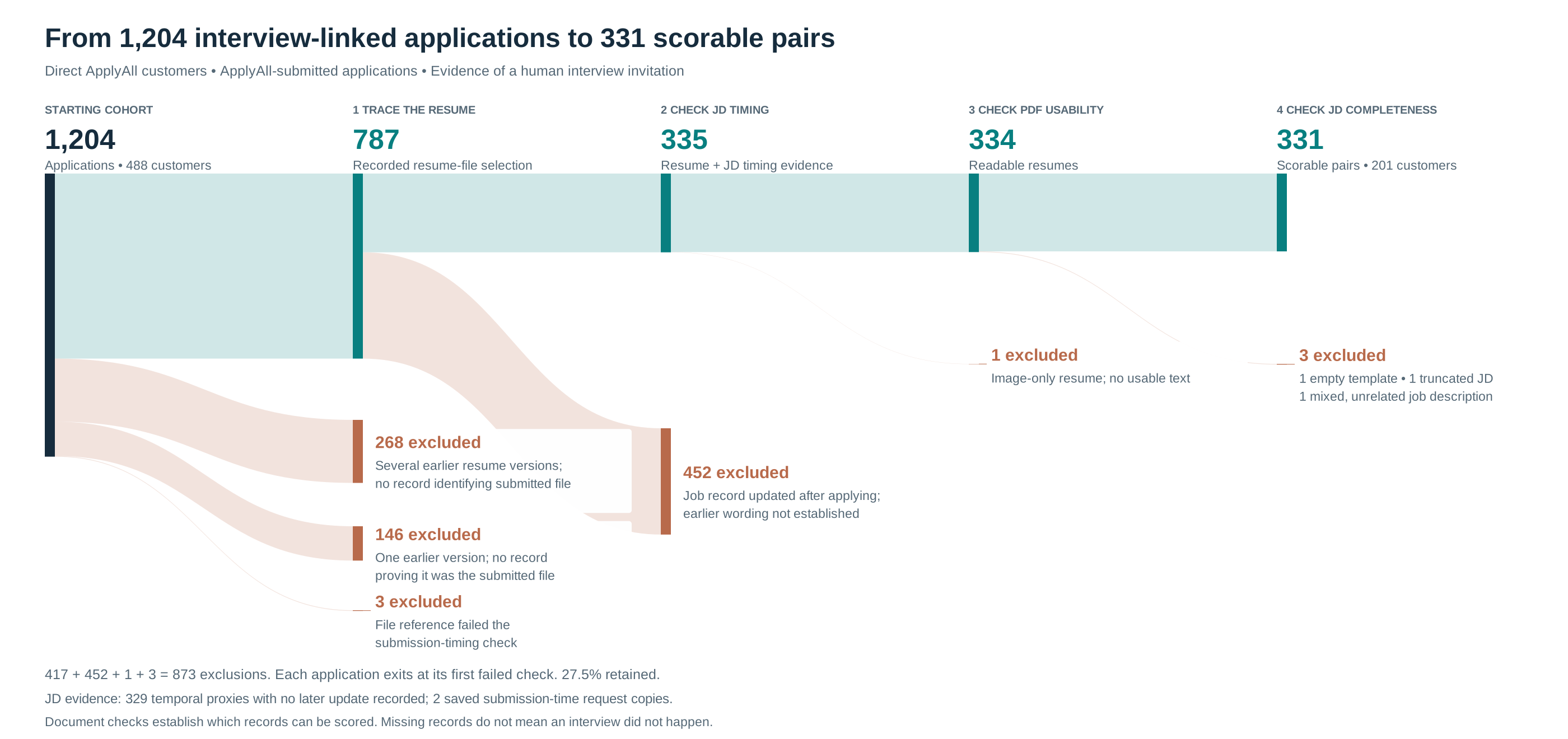
We started with 13,256 emails tagged as interview-related for ApplyAll customers, from January 1 through October 22, 2026.
To narrow that dataset down, we checked message content and grouped related messages (i.e. multiple emails in a single email chain talking about the same job). An invitation, three replies and a reminder shouldn’t magically become five opportunities.
For this study, an interview means an invitation to interview with a person. Assessments,
generic outreach and scheduling reminders don’t qualify. A confirmation or reminder could
support an opportunity we’d found, but it couldn’t stand in for the original invitation.
Next, we linked the invitation evidence to known applications submitted through
ApplyAll and kept one record per customer and job. That gave us 1,204 primary application
records across 488 customers.
This linking step has a real limitation. Usually, we found one matching employer and role among that customer’s known submissions, but sometimes a customer has applied to multiple jobs at the same company, or the sending domain used by the interviewers may not match the company’s primary domain.
We then needed a resume we could reasonably tie to the submission. That removed 417 applications: 268 had multiple earlier files without proof of which was selected; 146 had one earlier file but no selection proof; three had unreliable file-selection timing.
Of the 787 left, we withheld 452 because the job record had a recorded update after submission. That doesn’t prove the qualifications changed. It means we couldn’t establish the earlier description confidently enough to use it.
That left 335 pairs. We removed one image-only resume and three unusable descriptions: an empty template, a truncated description and a description mixing unrelated roles. Final count: 331 pairs, or 27.5% of the 1,204 linked applications.
Phew!
“100% of the requirements” needs a definition
There are a few different questions hiding inside “100% qualified.” We kept them separate.
Every explicitly required professional qualification: 52/184 (28.3%). Those applications involved 50 customers. Another 147 postings had no explicitly mandatory professional qualifications under our rules. We left them out of this percentage. An empty checklist is not an achievement.
Every professional qualification, including nice-to-haves and unmarked items: 11/331 (3.3%), involving 10 customers. The other 320 of 331 resumes didn’t fully document every item.
We’re counting application–resume pairs here. A customer can appear more than once, and different customers can apply to the same vacancy. A customer’s chance of appearing in the “at least one perfect match” count also depends on how many of their applications we observed.
There’s another wrinkle. “Every must-have” can be a much smaller checklist than “everything in the job post.” The median posting with any explicit professional must-haves had 6 of them. Some employers call a degree required and leave a whole list of technical skills unmarked.
Of the 52 perfect-must-have pairs, 40 had only one to three explicitly mandatory professional items. So we also checked a broader set: must-haves plus unmarked professional qualifications. Average coverage was 66.3%, and 26/329 (7.9%) documented every item. The label you choose changes the answer quite a bit.
| Qualification set | Eligible applications | Mean coverage | Median coverage | Every item met |
|---|---|---|---|---|
| Explicit must-haves | 184 | 66.5% | 71.4% | 52/184 (28.3%) |
| Nice-to-haves | 265 | 53.4% | 50.0% | — |
| Unmarked qualifications | 274 | 66.8% | 69.6% | — |
| All professional qualifications | 331 | 64.0% | 66.7% | 11/331 (3.3%) |
What about work authorization, travel and the rest?
Skills, experience, education, credentials and stated professional behaviors make up the professional qualification scores above. Work authorization, location, office attendance, travel and physical availability are separate conditions when the posting states them as candidate requirements.
Include those conditions and 28/221 (12.7%) fully documented every explicit must-have. Only 3/331 (0.9%) fully documented every scored qualification and condition.
That last number needs its explanation right beside it: 182 pairs had at least one condition or claim we couldn’t assess from the resume. A resume usually isn’t a complete answer to “will you travel?” or “will you need sponsorship?”
“We can’t tell” does not mean “this person fails.” These numbers measure complete documentation. They don’t establish legal eligibility, willingness or actual ability.
How we decided whether a requirement was met
First, we extracted qualifications from the job post. Then we compared the resume. Words such as required, must and minimum, or wording with the same force, made an item a must-have. Preferred, bonus and ideal wording made it a nice-to-have. A heading like “Qualifications” or “What you bring” didn’t automatically make every line mandatory. The rest stayed unmarked.
We split concrete combined skills where appropriate, kept alternatives such as “degree or equivalent experience,” and treated example tools as examples. A list beginning “such as” isn’t an instruction to collect every software brand named after it.
We didn’t automatically turn future duties into requirements for past experience. We assessed experience as of the application date, didn’t add overlapping jobs twice, and didn’t assume ten years of work meant ten years in a particular specialty.
Each item got one of five labels: fully met, partially met, not demonstrated, contradicted or not assessable. Only fully met earned a point in the strict score. Every retained item stayed in the denominator, including ones we couldn’t assess. We also report a separate version that leaves unassessable items out.
Missing evidence means the resume doesn’t show it. It doesn’t prove the person can’t do it. For communication or collaboration, we could credit concrete examples of the behavior. A senior title on its own wasn’t enough.
What we checked, and where judgment still comes in
We refined the scoring rules on a 30-pair pilot, then handled the remaining records in separate extraction and matching stages. Every final pair received a source review. In total, that covered 5,245 scored items: 4,838 professional qualifications and 407 conditions.
We also prepared separate AI-agent assessments for 10 additional application–resume pairs before seeing their model matches. We could directly compare the two assessments on 156 qualifications. The initial model and the separate assessment agreed on 129 labels. One additional item combined qualifications that the other method scored separately, so we left it out of the direct agreement comparison.
That’s agreement between coding methods, not accuracy against human-verified answers. We checked disagreements against the documents.
Every case initially scored as a complete match got another check against the source documents. For applications outside the 30-pair pilot, a different AI agent checked every qualification contributing to that complete-match result. We also checked 15 non-perfect cases: five near-perfect cases and ten others selected by a deterministic rule. We wanted to catch both generous scoring and evidence we’d missed.
The reviewers were AI agents. Matching review often included the initial model answer. This wasn’t independent human validation or a fully blinded study. We’ve kept the source quotations, original requirement lists, scoring records and reasons for changes privately so the decisions can be audited without exposing applicants’ information.
Source review sometimes changed how we interpreted a requirement, whether it was mandatory, or whether it applied to the advertised seniority level. Because some of these decisions came after initial scoring, we kept the original decisions and recorded why they changed. We also recalculated the results under alternate interpretations: broader readings of four cases involving product expertise, integration experience or specialist experience; including qualifications for other seniority levels; and requiring the exact bachelor’s credential rather than accepting a relevant completed advanced degree as meeting a general education minimum.
The scoring choices matter. Give partial evidence half credit and average must-have coverage rises to 78.8%; nice-to-have coverage rises to 62.1%. Count qualifications sharing the same source passage as one unit and the averages are 62.5% and 51.2%, respectively. These checks show how the choices affect the result. They don’t reveal one magically correct score.
Giving each customer equal weight, rather than each application, produces 67.0% must-have coverage and 54.4% nice-to-have coverage. The downloadable results also include customer-cluster bootstrap intervals: we resample customers with all their applications to see how the estimates move. Those intervals don’t fix errors in coding, job links or document history. They don’t make this selected group representative of everyone looking for work.
What we’d take from this
In this group, most resumes didn’t document every professional qualification in the job post. Requiring a complete match on paper would have ruled out most of the application–resume pairings we found associated with human interview invitations.
That gives us a reason to question a rule that demands a documented match on every professional qualification. It isn’t permission to turn 66.5% into a magic number.
We didn’t compare these applicants with people who received no invitation. We didn’t control for role or experience, and we don’t know what employers actually considered. Invitations missing from the email category, other application materials, referrals and unresolved job identities can all affect the result.
What we can say is this: a resume can leave listed qualifications undocumented and still win an interview invitation. What we can’t tell you from this study is how many boxes you personally need to check.
Tal Flanchraych, Founder of ApplyAll. Tal founded ApplyAll after a layoff from Indeed, where she was a product manager. LinkedIn
First time hearing about ApplyAll?
We apply to hundreds of jobs for you.
Reviewed by real humans. One-time payment, not a subscription. If you receive no qualifying interview within 30 days after we submit the final purchased application, you get a 100% refund, subject to the published terms.
More from the blog
- Older job listings still drive interviews
What 130,684 applications tell us about when to apply.
- Reject Rejections
Two new features for every ApplyAll user: an in-app inbox for recruiter mail, and a switch that turns off rejection emails.
- Philippines Trip
A site visit to the remote team that reviews every ApplyAll application, with notes on how the office came together.